How to Finance a Renovation in Australia: Equity First, Construction Loans for the Big Jobs — the 2026 Decision Tree
Renovation budgets get planned to the dollar while renovation financing gets improvised — usually expensively. The 2026 menu is actually a tidy decision tree with one governing rule: use the cheapest money that fits the project size, and let the loan structure protect your build, not just fund it. Here's the honest map.
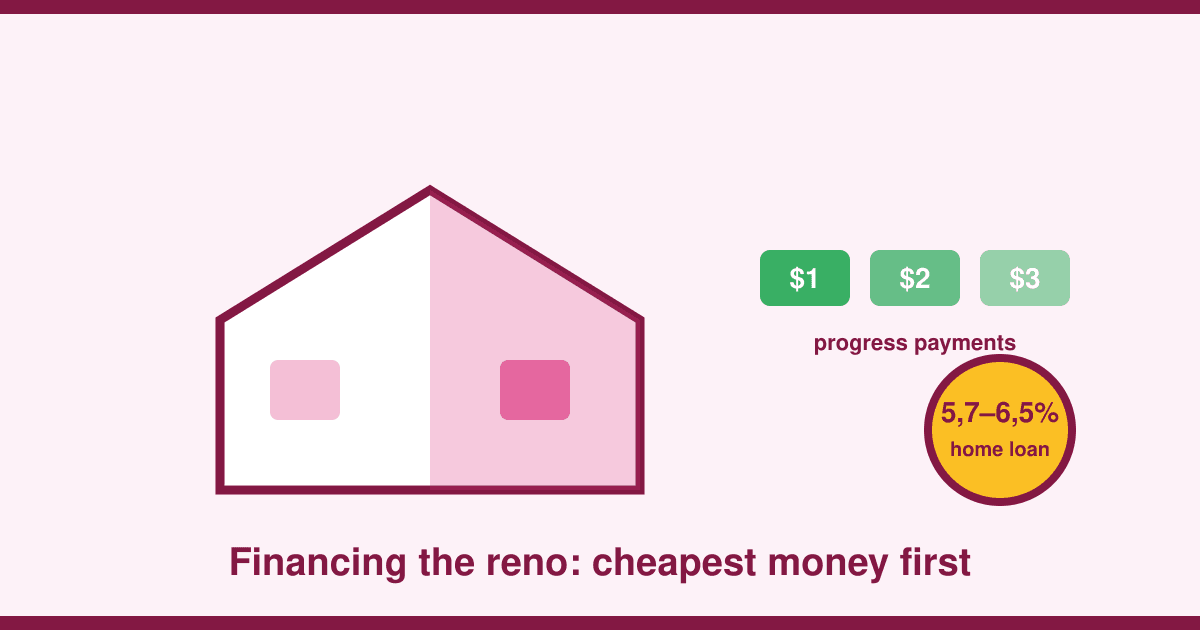
In short: For cosmetic work under $50,000, equity is king — a redraw of your advance repayments or a home-loan top-up at rates of roughly 5.7–6.5% (June 2026) is the cheapest borrowing available. For structural projects over $100,000, the renovation construction loan takes over: the bank releases funds in 5–6 staged progress payments, and you pay interest only on what's drawn. In between — non-structural work under $100k — you can typically control payments yourself, paying the builder on completion.
The decision tree
| Project | Best-fit financing |
|---|---|
| Cosmetic, under $50k (paint, kitchens, bathrooms without structure) | Equity: redraw or top-up — cheapest money, full control |
| Non-structural, under $100k | Equity top-up; you control payments to the builder |
| Structural, over $100k (extensions, lifts, rebuilds) | Construction loan — 5–6 staged progress payments, interest only on drawn funds |
| No usable equity, smaller projects | Personal loan — dearer, but fast and unsecured |
Why equity wins the small-and-medium jobs
The maths is unglamorous and decisive: home-loan rates (~5.7–6.5%) sit far below personal-loan and credit-card money, and if you're ahead on repayments, redraw turns your own surplus into the world's cheapest renovation fund. The top-up variant extends the mortgage against your equity — same cheap rate, assessed once. The discipline that keeps it smart: match the repayment plan to the renovation's life, not the loan's 25-year tail — cheap money left to amortise for decades quietly stops being cheap.
The construction loan — and why its bureaucracy is your friend
Over $100k structural, banks lend like builders think: valuation of the completed project, a fixed-price building contract, and funds released across 5–6 progress stages as work completes. Two under-appreciated features:
- Interest only on drawn funds: you're not paying interest on stage five's money while stage one pours — a real saving across a nine-month build.
- The bank checks before it pays: progress payments mean someone verifies work exists before money moves — a discipline that dovetails exactly with the contract-and-deposit protections renovators should demand anyway. A builder who resists staged payments is answering a question you didn't ask.
The admin trade-off is real — valuations, fixed-price contracts, staged inspections — which is why the tree matters: don't drag construction-loan bureaucracy into a $40k bathroom, and don't stuff a $250k extension onto a credit card.
Sizing the borrow honestly
Budget from real numbers, not renovation-show numbers — what bathroom renovations actually cost and kitchen renovation reality are the anchors — then add the contingency inside the approved facility: 10–15% for surprises, approved upfront, drawn only if needed. The alternative — going back to the bank mid-build for more — is slow exactly when you can't afford slow, and renovation timelines don't pause for credit assessments.
The valuation bonus nobody mentions: a well-chosen renovation can lift your property's value enough to restore the equity you spent — which is why banks lend against completed-value on construction loans. The corollary: over-capitalising (the $200k kitchen in the $600k suburb) breaks exactly this math, and lenders' completed-value appraisals are an early honesty check worth listening to.
The bottom line
Equity redraw or top-up for everything cosmetic, construction loan with staged payments once the project turns structural and six-figure, contingency approved inside the facility from day one — and let the bank's payment schedule double as your build-protection. Cheapest money, matched to project size, repaid on the renovation's timeline. And for the build itself: find vetted renovators near you here.
Frequently asked questions
Using equity in your home: redrawing advance repayments or topping up your home loan at rates of roughly 5.7–6.5% (June 2026) — far below personal-loan money. For cosmetic renovations under $50,000 it is the standard answer; personal loans fill the gap where equity is not available.
For structural projects over $100,000 — extensions, house lifts, rebuilds. The bank lends against the completed value with a fixed-price building contract and releases funds in 5–6 staged progress payments, charging interest only on drawn amounts. Non-structural work under $100,000 can typically be paid directly by you.
The lender releases money across 5–6 build stages as work completes, verifying progress before paying — you save interest by drawing gradually, and the verification discipline protects you from paying ahead of work done. Builders comfortable with staged payments are the ones to hire anyway.
10–15% for surprises — approved inside the loan facility upfront and drawn only if needed. Returning to the bank mid-build for extra funds is slow precisely when the project cannot afford delays.